North of Port Douglas the Great Barrier Reef gets quieter, clearer and harder to reach. There are no day boats out here: the Ribbon Reefs, the Cod Hole and Osprey Reef in the Coral Sea are dived from liveaboards out of Cairns and Port Douglas, and Lizard Island is a one-hour flight away. Here is how the far north works, what each site is like and who it suits.
Where are the Ribbon Reefs on the Great Barrier Reef?
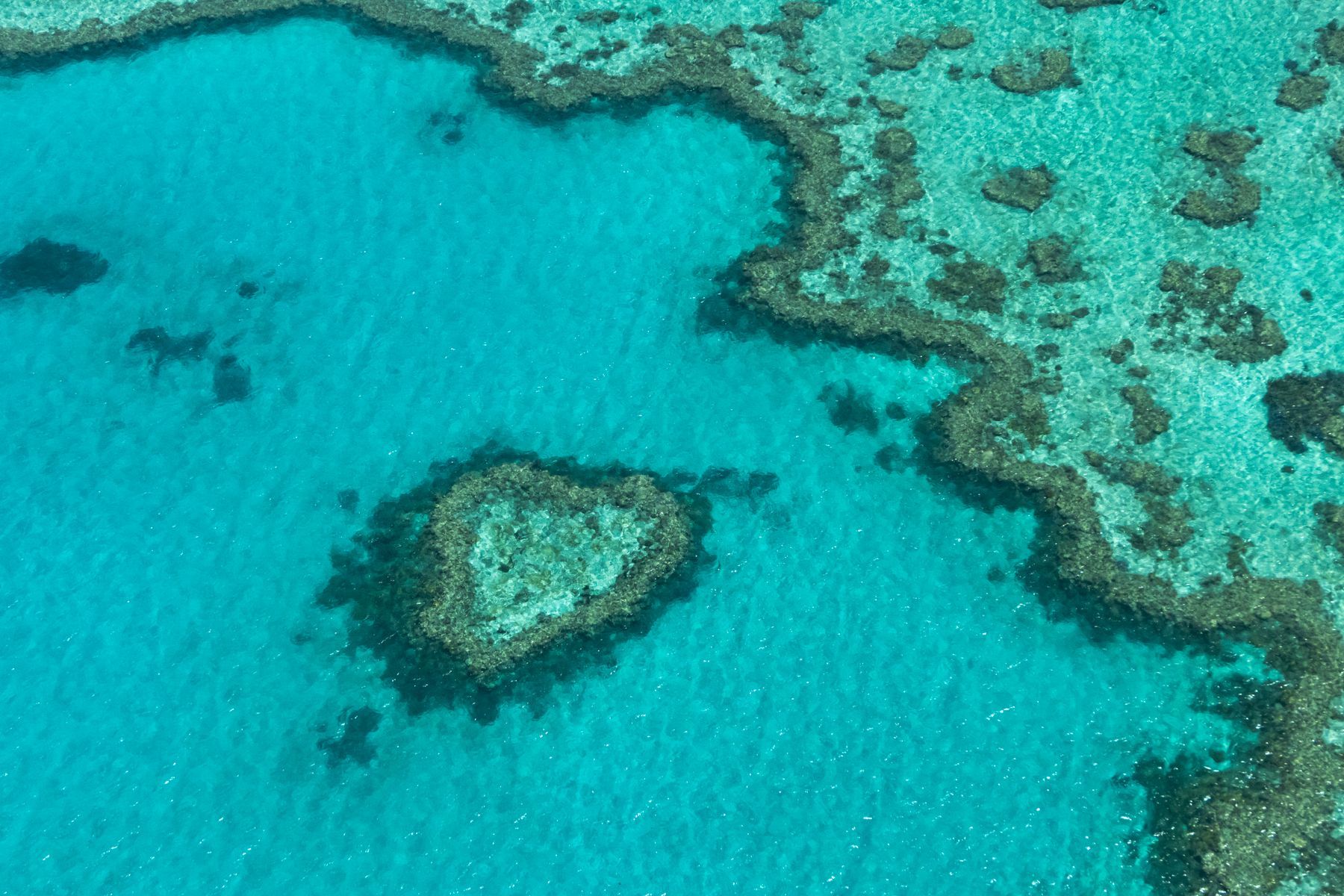
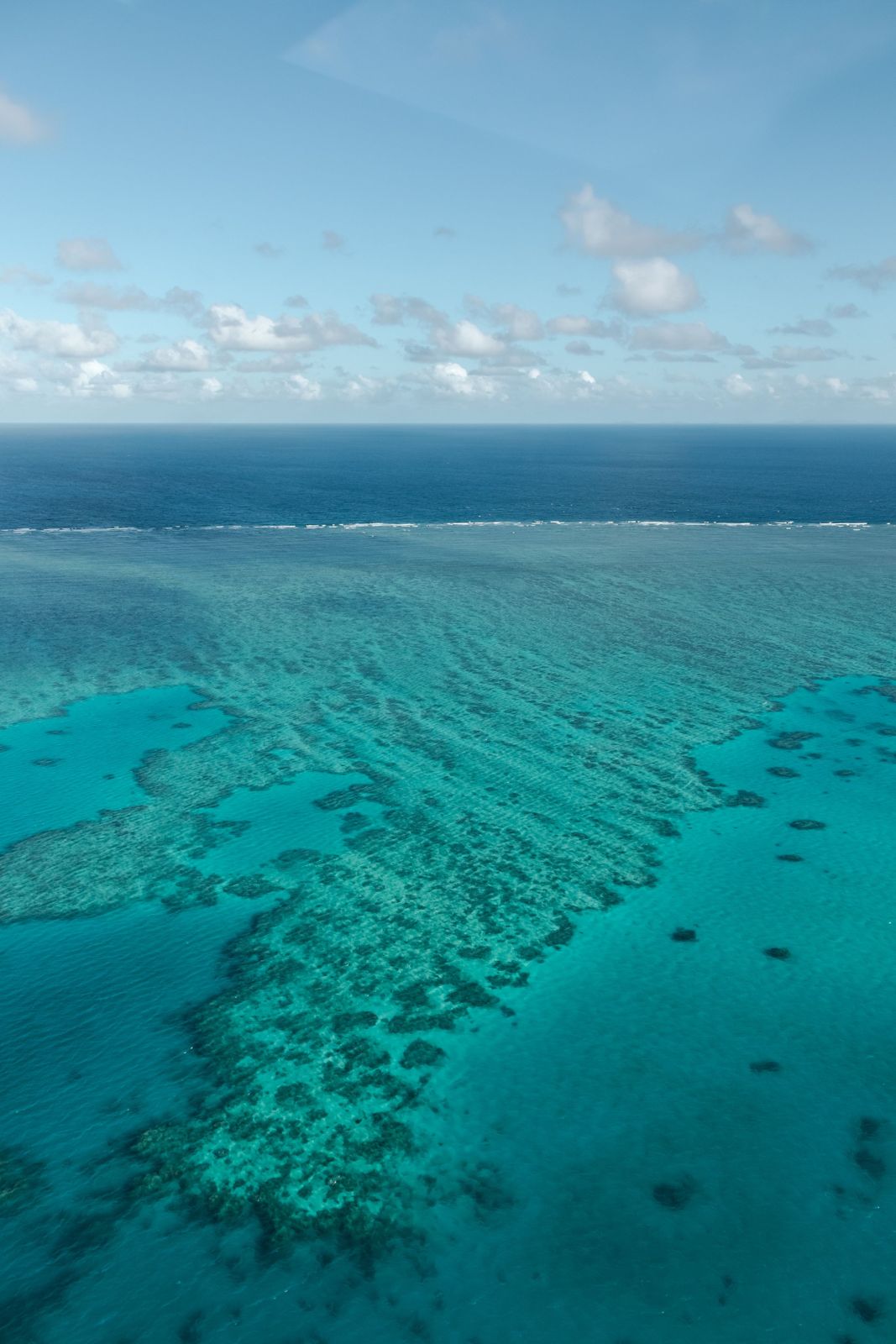
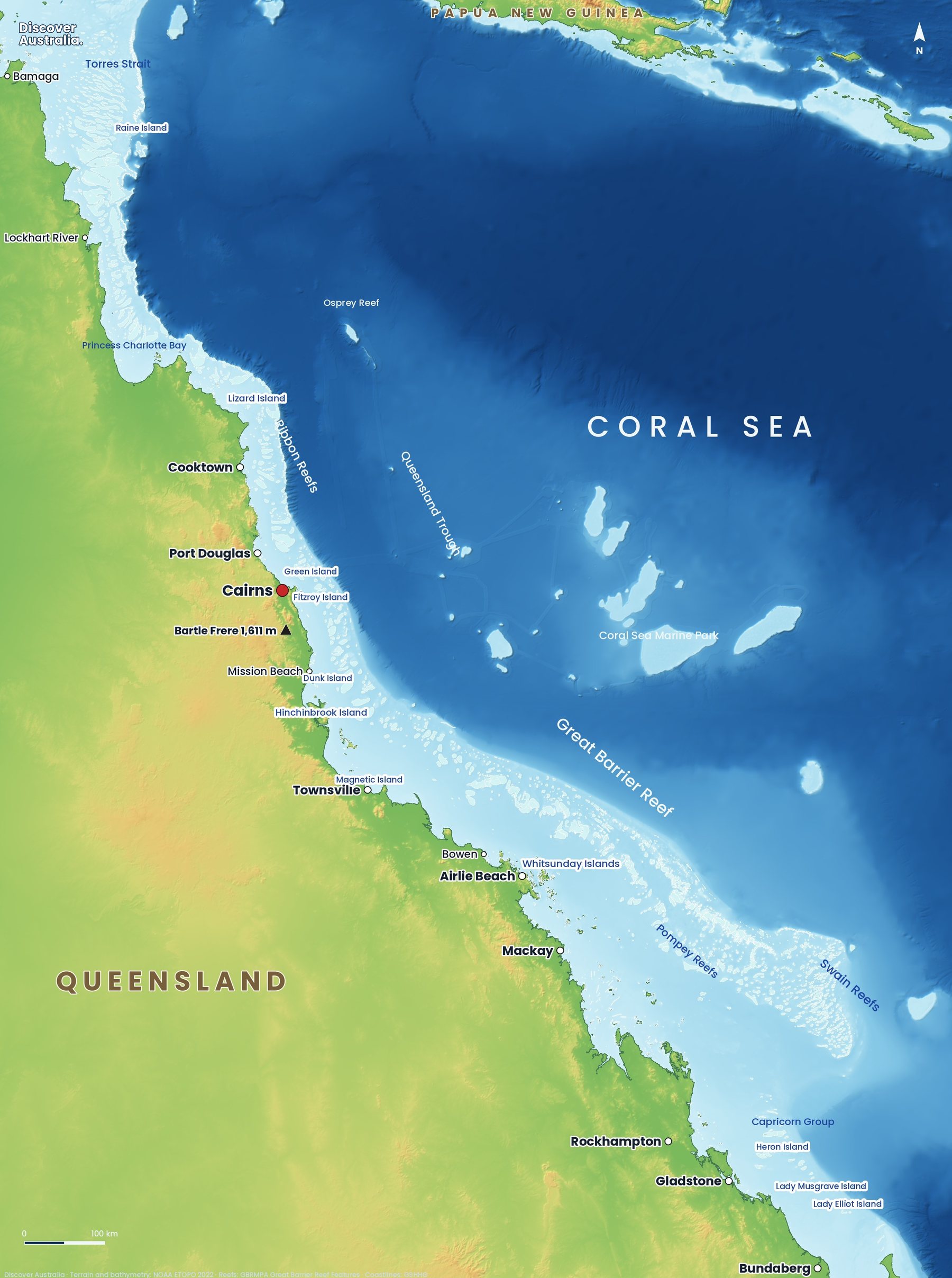
The Ribbon Reefs are a chain of ten long, narrow reefs on the outer edge of the continental shelf, running north from off Cooktown to near Lizard Island. They are numbered 1 to 10 from south to north. On their seaward side the shelf drops away into the deep water of the Coral Sea, which is why the water here is often clearer than on reefs closer to the coast.
The map below shows the four sites in this guide. Cooktown and its airport sit on the mainland coast to the west, with Howick Island, Eagle Island and Day Reef further north. Osprey Reef (site 1) lies far out to the north-east, beyond the shelf.
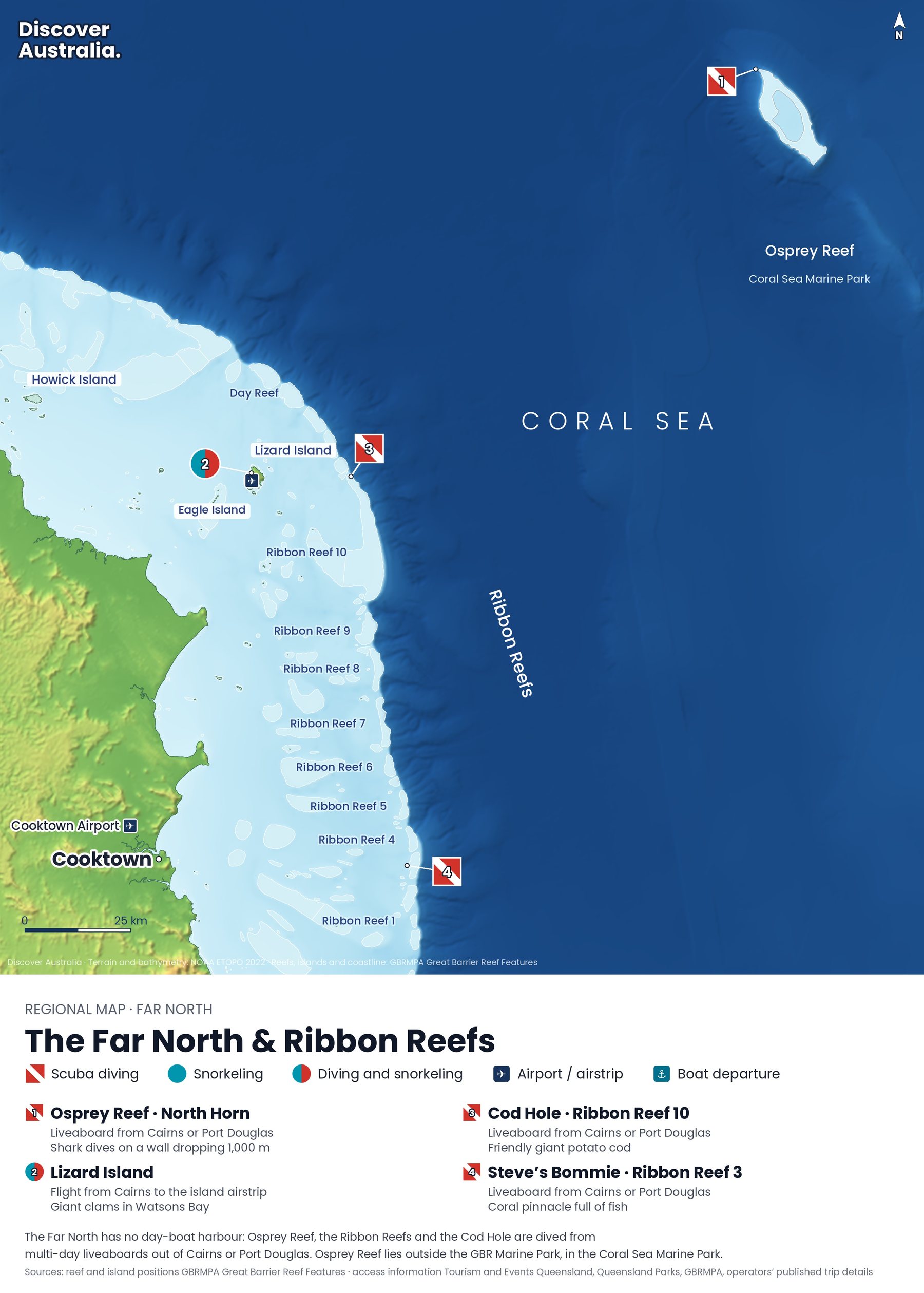
- Site 1, Osprey Reef · North Horn: liveaboard from Cairns or Port Douglas; shark dives on a wall dropping to about 1,000 m.
- Site 2, Lizard Island: flight from Cairns to the island airstrip; giant clams in Watsons Bay.
- Site 3, Cod Hole · Ribbon Reef 10: liveaboard; friendly giant potato cod.
- Site 4, Steve's Bommie · Ribbon Reef 3: liveaboard; a coral pinnacle full of fish.
For where this stretch fits on the whole reef, see our Great Barrier Reef map guide, or start with our Great Barrier Reef guide.
How do you get to the Ribbon Reefs and the Cod Hole?
You get there on a multi-day liveaboard dive boat from Cairns or Port Douglas. The far north has no day-boat harbour, and the Ribbon Reefs are too far from any town for a return trip in a day. Liveaboards leave from Trinity Wharf in Cairns and steam north overnight.
Trips come in a few standard shapes:
- Fly-dive, 3 or 4 nights: you take a scenic flight from Cairns to Lizard Island and join the boat at the top of the Ribbon Reefs, then sail back to Cairns (or the other way round). This saves days of steaming and gives you a low-level view of the reef.
- 5 nights: Ribbon Reefs plus a run out to the Coral Sea, or a slower Great Barrier Reef and Ribbon Reefs trip.
- 7 nights, Cairns return: the full loop. A typical itinerary covers Ribbon Reefs 9 and 10 including the Cod Hole, a night at Watsons Bay off Lizard Island, two days at Osprey Reef (weather permitting) and a last day at Ribbon Reef 3 or Bougainville Reef.
Expect up to about 26 dives on a seven-night trip, including night dives. Itineraries are samples only: crews change sites with the wind and swell, and the Coral Sea leg can be dropped in strong winds. Leave at least 24 hours between your last dive and any flight, as operators advise.
If you only have a day, the closest equivalent is the outer reef from Port Douglas, where day boats reach Agincourt Reefs, or from Cairns. Our guide to choosing a Great Barrier Reef tour compares day trips with liveaboards.
How much does a Ribbon Reefs liveaboard cost?
Expect from about A$2,500 per person for a three-night fly-dive trip in a budget cabin, and from about A$4,750 to A$4,800 for seven nights, on published 2026/27 rates. Prices include meals, tanks and weights; better cabins cost more.
| Trip (2026/27 published rates) | Nights | Reaches | From, per person |
|---|---|---|---|
| Fly-dive Cod Hole | 3 | Ribbon Reefs, Cod Hole | About A$2,500 |
| Minke whale fly-dive (June–July 2026) | 3 | Ribbon Reefs | About A$2,540 |
| Fly-dive Coral Sea | 4 | Ribbon Reefs, Coral Sea | About A$2,835 |
| Coral Sea and Cod Hole | 5 | Coral Sea, Cod Hole | About A$3,430 |
| Seven-night Coral Sea trip, quad-share cabin | 7 | Ribbon Reefs, Cod Hole, Osprey Reef | About A$4,750 |
| Seven-night Coral Sea safari, budget cabin | 7 | Ribbon Reefs, Cod Hole, Osprey and Bougainville reefs | About A$4,800 |
The quad-share seven-night trip is Spirit of Freedom's; the other rows are Mike Ball Dive Expeditions' 2026/27 rates. Both operators run 3-, 4- and 7-night trips from Cairns. Check whether the Reef Authority's environmental management charge (A$8.50 per person per full day) is included: some fares include reef levies, others add them on board. Rates for 2027/28 are higher, so confirm the price for your dates.
What is the Cod Hole like?
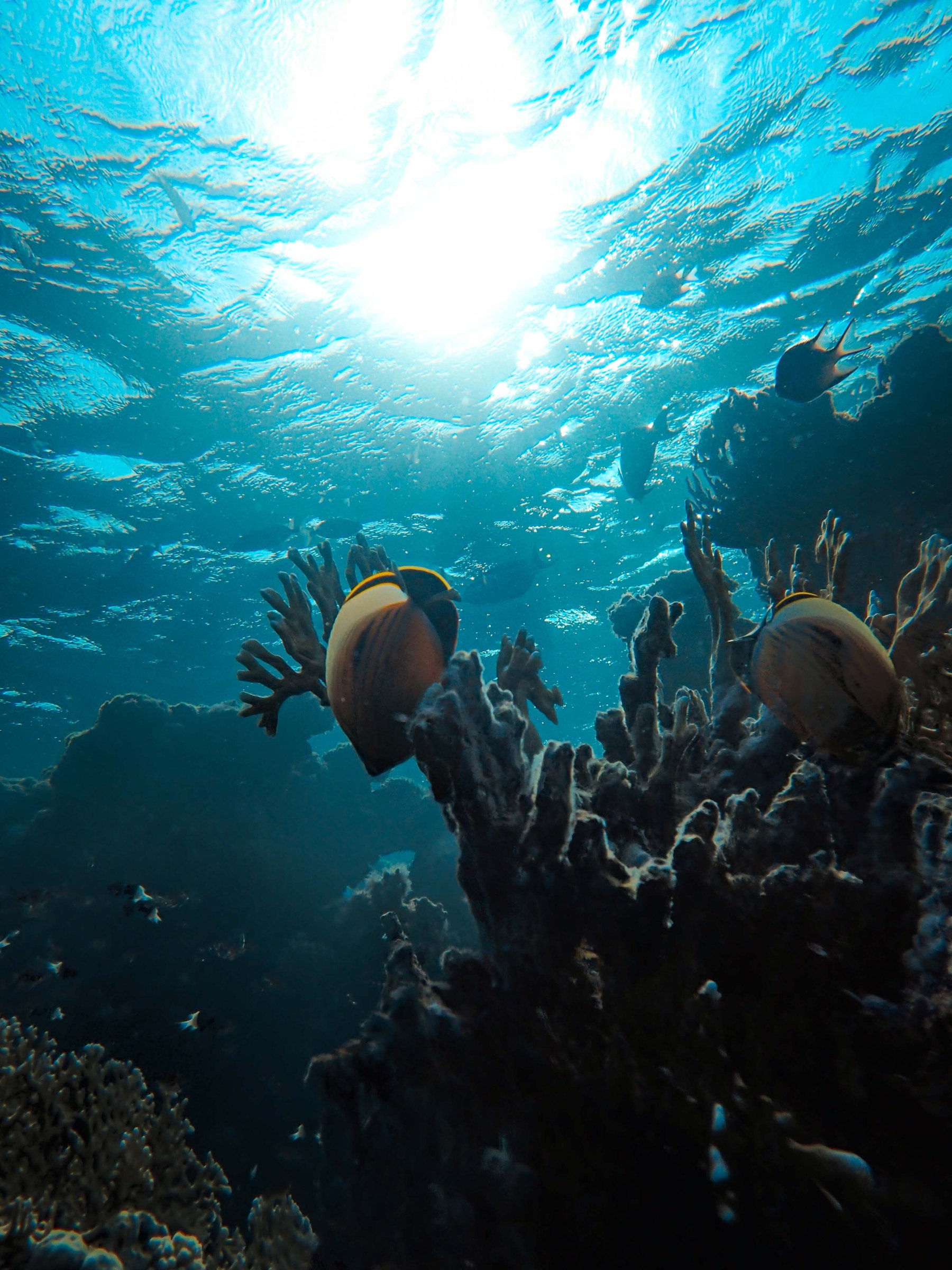
The Cod Hole on Ribbon Reef 10 (site 3 on the map) is a dive site famous for giant potato cod that come right up to divers. These groupers can reach about 2 m long and about 100 kg, and they are curious rather than shy.
The site was made famous by underwater photographers Ron and Valerie Taylor, and it was one of the places singled out when the Great Barrier Reef was World Heritage listed in 1981. It has had hard years: Cyclones Ita (2014) and Nathan (2015) and the 2016 mass bleaching stripped much of its coral, and the cod moved away. In October 2025 the Reef Authority reported that fast-growing corals had regrown and that divers were again seeing up to five potato cod per dive. The Cod Hole is now one of 26 stewardship sites where tourism operators help monitor and protect the reef.
On an incoming tide a current runs through the site, which can turn it into a drift dive. Snorkellers can join on calm days, but this is mainly a scuba site. For how the reef as a whole is coping, read Is the Great Barrier Reef dying?
What can you see at Steve's Bommie?
Steve's Bommie on Ribbon Reef 3 (site 4) is a coral pinnacle that rises from about 30 metres to within about 5 metres of the surface, and it is packed with fish. You spiral up around it on a single dive, so it suits both wide-angle and macro photographers.
- Schooling fish: bigeye trevally, barracuda, yellow-lined snapper, Moses perch and goatfish.
- Small things: nudibranchs, flatworms, pipefish, scorpionfish, lionfish, mantis shrimps and flaming file shells.
- Near the top: several species of anemonefish.
- Watch your hands: highly venomous reef stonefish live here too, so do not touch or kneel on the reef.
Other well-known Ribbon Reef sites include Pixie Pinnacle, a small bommie rising from about 30 metres to just below the surface, plus Lighthouse Bommie and Dynamite Pass. Our Great Barrier Reef snorkelling and diving guide maps these alongside sites further south.
Is Osprey Reef part of the Great Barrier Reef?
No. Osprey Reef (site 1) lies outside the Great Barrier Reef Marine Park, in the Coral Sea Marine Park, which is managed by Parks Australia rather than the Reef Authority. It is more than 300 km from Cairns and sits alone on top of a seamount that rises almost vertically from the ocean floor.
The reef is almost 30 km long and covers more than 180 square kilometres. Its walls at North Horn, Admiralty and False Entrance step down to about 1,000 metres, and visibility is often 30 to 60 metres.
- Sharks: grey reef sharks and whitetip reef sharks are common all year. Silvertip sharks are often seen at North Horn, and scalloped hammerheads gather off the walls in the cooler months.
- Shark dive: some liveaboards run a controlled shark attraction dive at North Horn, where operators say 10 to 40 sharks can turn up.
- Experience: Parks Australia says Osprey Reef is for experienced divers. Operators ask for Advanced Open Water certification or about 15 to 20 logged ocean dives, with at least 5 in the past 12 months.
Only the Ribbon Reefs part of a Coral Sea trip suits snorkellers. Crossing to Osprey takes an overnight passage, and in strong trade winds the boat may stay on the Ribbon Reefs instead. Read more about how the two parks fit together in our guide to Australia's marine parks.
When can you swim with dwarf minke whales?
In June and July, when dwarf minke whales gather on the Ribbon Reefs. It is the only known predictable gathering of this whale anywhere, and swims run from liveaboards out of Cairns and Port Douglas.
Dwarf minkes grow to about 8 metres and are often curious. The encounters are tightly managed:
- Permits: only operators with a Reef Authority permit can run swims, and the number of permits is capped.
- Ropes: snorkellers hold on to surface lines trailed from the boat, so the whales choose how close to come.
- Rules: no swimming towards a whale, no intentionally approaching within 30 metres, no touching and no flash photography. Only one boat may interact with a group of whales at a time.
No scuba tank is needed for the swim, so non-divers can join a minke trip. Departures are few and fill early, so book months ahead. For what else happens on the reef each month, see the best time to visit the Great Barrier Reef.
Can you visit Lizard Island without staying at the resort?
Yes, but it takes planning. Lizard Island (site 2) is a national park, and you can camp at Watsons Bay if you book a camping permit. There are no scheduled flights or boats for non-resort guests, so campers charter a plane from Cairns or Cooktown, or a boat from Cairns, Port Douglas or Cooktown.
The island is about 250 km north-east of Cairns and 93 km north-east of Cooktown. Its Traditional Owners, the Dingaal people, call it Jiigurru and work with Queensland Parks and Wildlife Service to manage the park. James Cook named the island in August 1770 after its monitor lizards and climbed its highest point to look for a way out through the reefs.
The resort: Lizard Island Resort is all-inclusive and about an hour's scenic flight from Cairns. Children must be 10 or older. Resort facilities are for guests only, apart from the Marlin Bar, which is not open every day.
The campground:
- Sites: five unnumbered tent sites on sand, about 1.2 km walk from the airstrip, with limited shade.
- Facilities: composting toilet, picnic tables and a free hot-plate barbecue. No fires, no generators, no bins and no phone coverage.
- Water: bore water from a hand pump, which must be treated before drinking.
- Fees: Queensland camping permits cost A$7.75 per person per night, or A$31 per family, from 1 July 2026.
What to do: snorkel the Clam Gardens in Watsons Bay at high tide, where giant clams grow up to about 2 m long among the corals, or the sheltered Blue Lagoon. Fit walkers can climb Cooks Look, a 2.25 km return walk graded very difficult, to the 359 m summit for views over the reefs. Ask about tours of the Lizard Island Research Station, run by the Australian Museum since 1973.
The beach next to Eagle Island at Eyrie Reef is closed from 1 October 2026 to 25 March 2027 for nesting seabirds. For more island stays, see our Great Barrier Reef islands guide.
Is the far north reef worth it for you?
It is worth it if you are a keen diver with at least three nights and a bigger budget. The far north gives you remote reefs, few other boats and some of the reef's best-known dive sites. It is not the right choice for a first look at the reef on a short trip.
| You are… | Best far north option |
|---|---|
| A certified diver with 3–4 nights | Fly-dive Ribbon Reefs and Cod Hole trip |
| An experienced diver who wants sharks and walls | Seven-night trip with Osprey Reef |
| A snorkeller or non-diver who loves whales | June–July minke whale trip |
| A couple after a splurge on land | Lizard Island Resort (ages 10+) |
| A self-sufficient camper | Watsons Bay campground by charter |
| A first-timer with one day | Day trip from Port Douglas or Cairns instead |
A few practical points before you book:
- Stingers and crocodiles: dangerous jellyfish can be in coastal waters at any time and are more common in the warmer months, so wear a full-body lycra suit. Crocodiles can turn up on beaches and offshore islands, so follow local signs. Our dangerous animals guide explains the risks.
- Medical forms: liveaboards ask for medical clearance if you have a medical condition or take prescription medication. Sort this out before you fly.
- Weather: the trade winds can stop boats crossing to the Coral Sea, so treat Osprey Reef as a bonus, not a promise.
- Your base: you will start and end in Cairns or Port Douglas. Our Cairns vs Port Douglas vs Airlie Beach comparison helps you choose.
Heading further south? Our regional reef guides cover Port Douglas, Cairns, Mission Beach to Townsville, the Whitsundays and the southern reef.
Facts checked October 2026. Liveaboard prices, itineraries, camping fees and closures change; confirm with the operator, Queensland Parks and Wildlife Service and Parks Australia before you travel.
- Osprey Reef, Coral Sea Marine Park (Parks Australia)
- The Cod Hole is back (Great Barrier Reef Marine Park Authority)
- Environmental management charge (Great Barrier Reef Marine Park Authority)
- Swim-with dwarf minke whales, Great Barrier Reef case study (International Whaling Commission)
- Swimming with dwarf minke whales (Tourism Tropical North Queensland)
- Watsons Bay camping area, Lizard Island National Park (Queensland Parks and Wildlife Service)
- Lizard Island National Park: visiting safely (Queensland Parks and Wildlife Service)
- Lizard Island National Park: nature, culture and history (Queensland Parks and Wildlife Service)
- Camping bookings and fees (Queensland Parks and Wildlife Service)
- Lizard Island fact sheet (Tourism and Events Queensland)
- Liveaboard prices 2026/27 (Mike Ball Dive Expeditions)
- 7-night Great Barrier Reef and Coral Sea liveaboard (Spirit of Freedom)