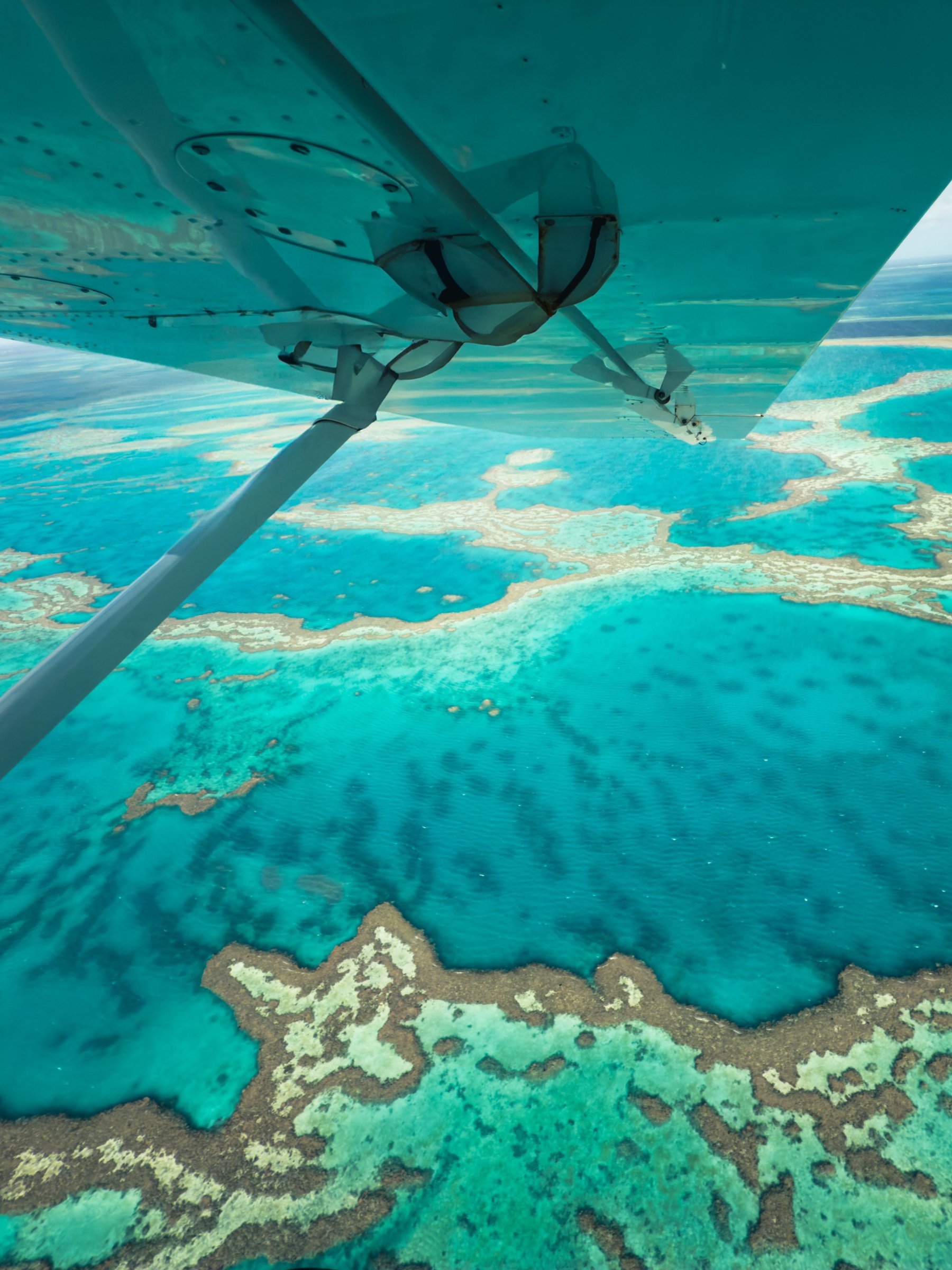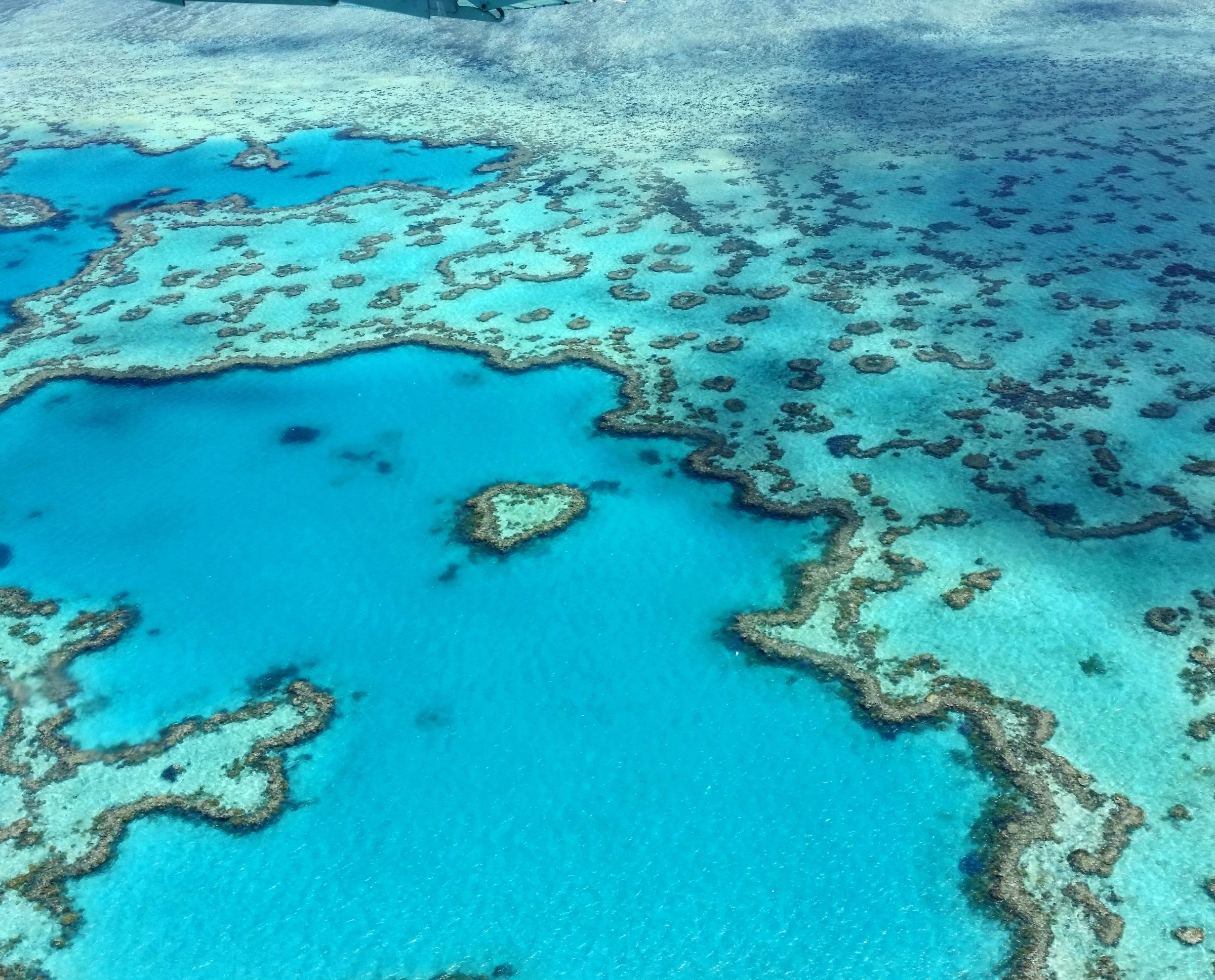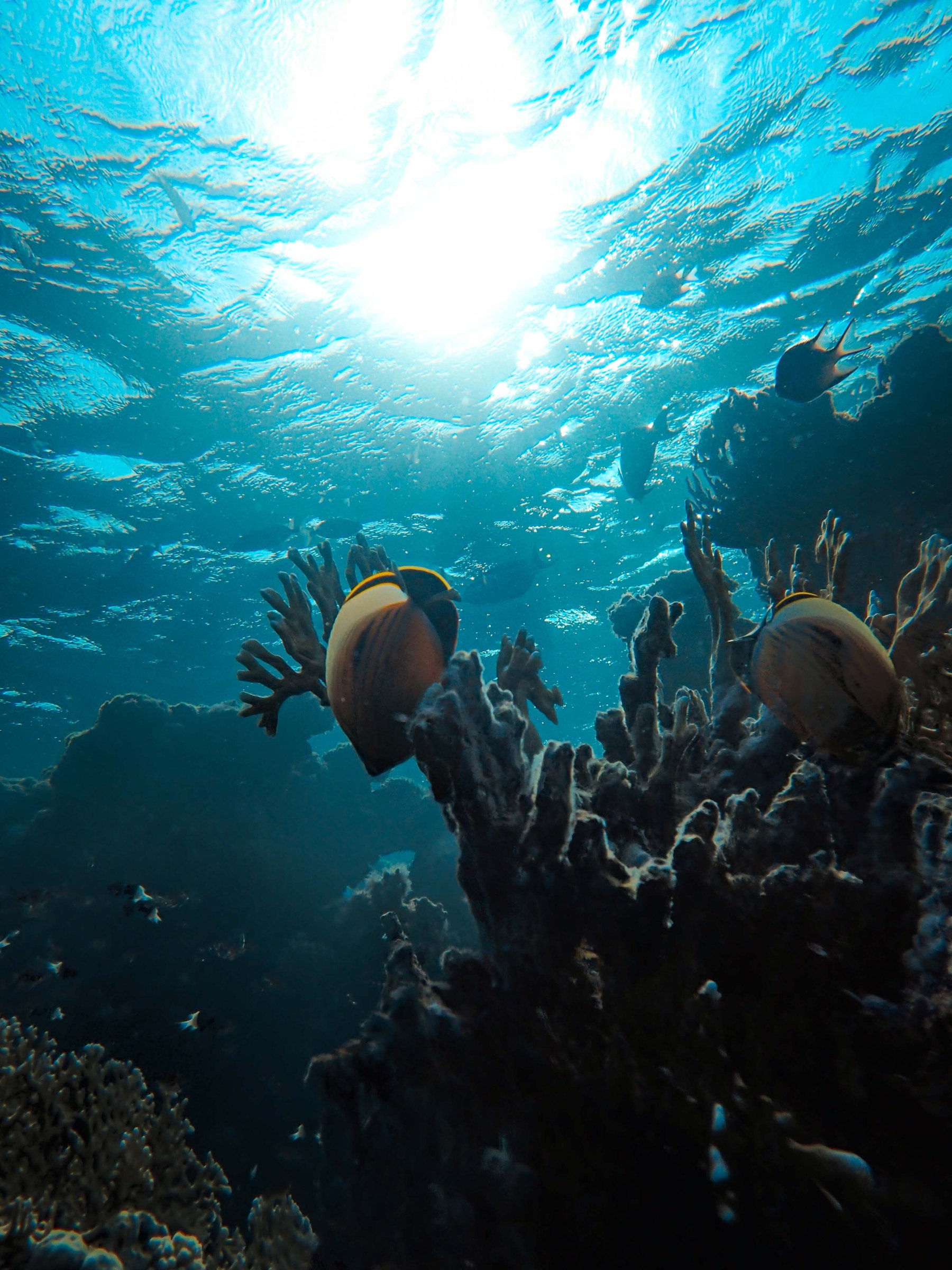
Headlines swing between "the reef is dead" and "the reef is fine". Neither is true. The Great Barrier Reef is alive, still has more coral than many reefs worldwide, and is bouncing back in places, but it has bleached six times in ten years. Here is what the official surveys actually show.
Is the Great Barrier Reef dying?
No, the Great Barrier Reef is not dead or dying in the sense the headlines suggest, but it is under more pressure than at any time since monitoring began. Both popular claims miss the point.
- "It's dead": wrong. Coral cover in the northern and central reef in 2026 was above the long-term average, and most surveyed reefs had 10 to 50% hard coral cover. You can still snorkel over healthy, colourful coral on most trips.
- "It's fine": also wrong. High coral cover is now driven by fast-growing corals that are the first to die in a heatwave. The Australian Institute of Marine Science (AIMS) calls the increase in bleaching over the last decade unprecedented.
What scientists actually say is that the reef is resilient but increasingly volatile. AIMS describes coral cover that "now swings between very low and very high levels", and names climate change as the greatest threat to the reef's future.
What did the latest AIMS surveys find?
The latest AIMS reports show a sharp fall in 2025, then a partial rebound in 2026. AIMS has monitored the reef for 40 years, towing snorkellers behind boats to estimate how much of the seabed is covered in living hard coral.
The Annual Summary Report 2024/25, released on 6 August 2025, surveyed 124 reefs between August 2024 and May 2025. Coral cover fell in all three regions, and the declines in the north and south were the largest in a single year since monitoring began. Some reefs near Lizard Island lost up to 70% of their coral.
The 2025/26 report, released on 11 August 2026, surveyed 121 reefs. Cover rose in the north and centre, and held steady in the south. 28% of reefs improved, 56% showed no net change and 16% declined.
| Region | 2024 | 2025 | 2026 | Long-term average |
|---|---|---|---|---|
| Northern (Cape York to Cooktown) | 39.8% | 30.0% | 35.1% | 27.0% |
| Central (Cooktown to Proserpine) | 33.2% | 28.6% | 31.6% | 20.0% |
| Southern (Proserpine to Gladstone) | 38.9% | 26.9% | 26.4% | 29.3% |
Hard coral cover by region, AIMS Long-Term Monitoring Program. The 2024 figures were record highs for the north and centre.
What happened to the reef in 2024 and 2025?
The reef bleached in two summers in a row, which has happened only twice in a decade. In 2024 aerial surveys found bleaching on about three quarters of 1,080 reefs assessed, during the fourth global bleaching event that NOAA confirmed on 15 April 2024. Southern reefs had the highest heat stress ever recorded there. Our article on the 2024 mass bleaching covers that summer in detail.
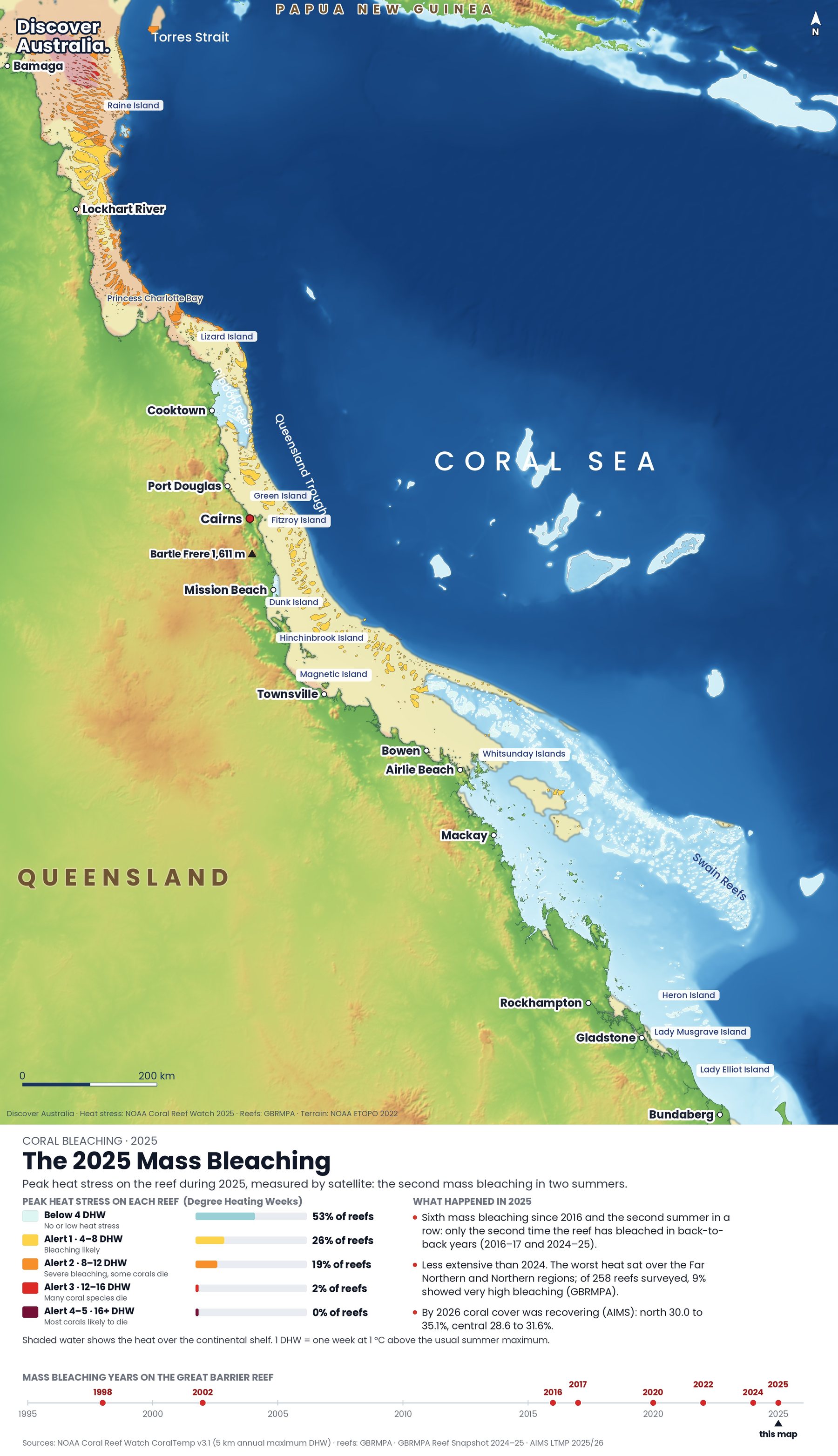
The 2025 event, the sixth mass bleaching since 2016, was less extensive. The worst heat sat over the Far Northern and Northern regions. Of 258 reefs surveyed from the air in March 2025, 9% showed very high bleaching, according to the Reef Authority. A flood in February 2025 also bleached and killed shallow coral on some inshore reefs around the Palm and Family islands.
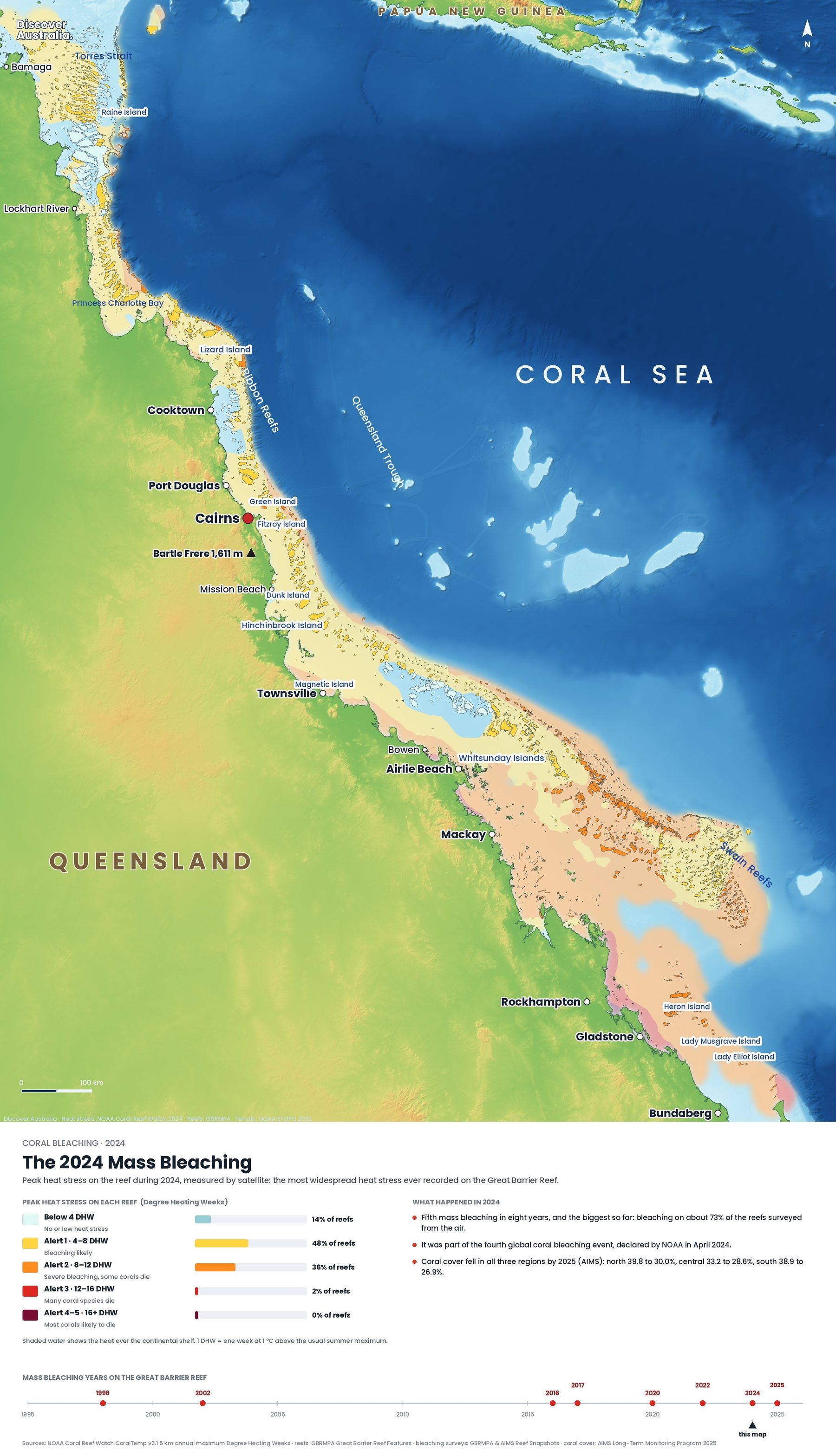
In 2026 there was no repeat mass bleaching. A regional event hit the north and centre, but a late-summer monsoon cooled the water and likely limited the damage.
What else damages the reef besides heat?
Cyclones, crown-of-thorns starfish and poor water quality all kill coral, and they hit hardest when reefs are already weakened by heat.
- Crown-of-thorns starfish: these native starfish eat live coral. Four major outbreaks have been recorded since the 1960s, and AIMS says rising numbers in the north suggest a fifth wave has begun.
- Cyclones: two severe cyclones added to the 2024/25 losses, including Jasper near Cairns. Category 5 Cyclone Narelle crossed the northern reef in March 2026; AIMS will assess its full impact in 2027.
- Water quality: sediment and nutrients washed off farmland and cleared land cloud the water and feed starfish outbreaks. Floods carry the worst of it onto inshore reefs.
How quickly can coral recover?
A reef can regain lost cover within a few years, but only if it is left alone long enough. Northern and central reefs climbed from lows around 2018 to record highs by 2024, and southern reefs rose rapidly from a 2011 low to 2017.
The catch is what grows back. Much of the recovery comes from Acropora, the branching and table corals that AIMS calls "the fastest to grow and are the first to go". They are sensitive to heat, easily broken by cyclones and a favourite food of crown-of-thorns starfish. That creates a boom-and-bust pattern: cover soars, then crashes in the next heatwave.
Slower-growing corals that are badly bleached can take many years or decades to recover, according to the Reef Authority. With mass bleaching now arriving every year or two, AIMS warns that what looks like complete recovery can be reversed in a single year.
Is the Great Barrier Reef on the UNESCO "in danger" list?
No. The reef, World Heritage listed since 1981, has never been placed on the List of World Heritage in Danger, although it has come close several times.
- 2021: UNESCO recommended an "in danger" listing, but in July the World Heritage Committee decided against it after heavy lobbying by Australia.
- 2023: UNESCO advised against listing but gave Australia until 1 February 2024 to report progress. The Committee agreed in September 2023.
- 2024: meeting in New Delhi in July, the Committee again did not list the reef, and asked for a State of Conservation report by 1 February 2026.
- 2025: the Committee raised concerns about bleaching, flooding and slow progress on climate change and water quality.
- 2026: meeting in Busan in July, the Committee decided not to list the reef. Australia must report on water quality progress by 1 December 2028 and on the reef's overall state by 1 December 2029.
Supporters of listing argue it would push faster climate action. The Australian and Queensland governments argue their management, including starfish control, is working. Both sides agree that climate change is the main threat.
What is being done to protect the reef?
The reef is managed under the Reef 2050 Long-Term Sustainability Plan, a joint Australian and Queensland government plan first released in 2015. The federal government has committed a record A$1.2 billion to protect, manage and restore the reef to 2030, part of more than A$4.4 billion in joint funding from 2014–15 to 2029–30.
- Starfish control: since 2012 the Reef Authority's divers have culled more than 1.4 million crown-of-thorns starfish, injecting them with bile salts or vinegar, and suppressed outbreaks on 452 reefs. UNESCO called the program effective in 2026.
- Water quality: catchment work repairs gullies and stream banks to cut the sediment reaching the reef.
- Protected zones: about a third of the Marine Park is green zone, where fishing and collecting are banned. Read how Australia's marine parks work.
- Restoration and art: the Coral Greenhouse by Jason deCaires Taylor, installed at John Brewer Reef off Townsville in 2019, sits at 12 m and holds coral cuttings salvaged from the seabed, which local schoolchildren tend.
Scientists are clear that local action buys time but cannot replace cutting greenhouse gas emissions.
Should you still visit the Great Barrier Reef?
Yes. The reef stretches along most of the Queensland coast, and good operators take you to sites with healthy coral and abundant fish. Visiting also helps: the environmental management charge included in your ticket goes directly to managing the Marine Park.
- Choose a High Standard Tourism Operator: the Reef Authority lists operators independently certified by schemes such as Ecotourism Australia and EarthCheck.
- Don't touch or stand on coral, and use a stinger suit rather than lots of sunscreen.
- Report what you see through the Reef Authority's Eye on the Reef program.
Start with our Great Barrier Reef guide, then see how to choose a reef tour and the best time to visit the Great Barrier Reef.
Facts checked October 2026. Coral cover changes every year and new surveys are released each August; check AIMS and the Reef Authority for the latest figures.
- Annual Summary Report on Coral Reef Condition 2024/25, media release (Australian Institute of Marine Science)
- Annual Summary Report 2024/25, quick look (Australian Institute of Marine Science)
- World's biggest coral survey confirms sharp decline after heatwave (Australian Institute of Marine Science)
- Great Barrier Reef condition summary 2025/26 (Australian Institute of Marine Science)
- Annual Summary Report 2025/26, media release (Australian Institute of Marine Science)
- Reef Snapshot: Summer 2024–25 (Great Barrier Reef Marine Park Authority, AIMS, CSIRO)
- NOAA confirms fourth global coral bleaching event (NOAA)
- Crown-of-thorns starfish management (Great Barrier Reef Marine Park Authority)
- Crown-of-thorns Starfish Control Program fact sheet (Great Barrier Reef Marine Park Authority)
- Media statement: World Heritage Committee decision, 2024 (Great Barrier Reef Marine Park Authority)
- World Heritage Committee decision on the Great Barrier Reef, 2026 (Great Barrier Reef Marine Park Authority)
- Record Budget boost to protect Great Barrier Reef (Minister for the Environment and Water)
- Choosing a high standard tourism operation (Great Barrier Reef Marine Park Authority)