Uluru is worth seeing in any month, but the desert sets the terms. Winter brings mild days and frosty nights, summer brings heat, flies and the chance of storms that send water pouring off the rock. Here is how each month feels, when walks close in the heat, and how to plan the practical side of your visit.
When is the best time to visit Uluru?
The best time to visit Uluru is May to September, when Parks Australia says cooler weather makes walking safer and more pleasant. Days in these months usually reach 20 to 30°C, rain is rare and the sky is often clear.
The trade-off is cold nights and the busiest season. July nights average 4.5°C at Yulara, so pack a warm jacket for sunrise. August and September are usually the best months for wildflowers, and they still have comfortable days, which makes them a strong pick.
October to March is hot and stormy. It is quieter and still rewarding if you walk at dawn and rest in the middle of the day. For how the Red Centre fits with the rest of the country, see our month-by-month guide to Australia.
What is the weather like at Uluru month by month?
Uluru swings from hot summers to cool, dry winters. The averages below come from the Bureau of Meteorology's Yulara Airport station, the closest to the rock, with records from 1983. Park hours are Parks Australia's opening times for each month.
| Month | Avg max | Avg min | Avg rain | Park hours | What to expect |
|---|---|---|---|---|---|
| January | 38.6°C | 23.1°C | 29 mm | 5 am–9 pm | Hottest month; flies, storms |
| February | 37.1°C | 22.3°C | 37 mm | 5 am–9 pm | Very hot; chance of storms |
| March | 34.7°C | 19.7°C | 34 mm | 5.30 am–8.30 pm | Still hot; quieter |
| April | 30.0°C | 14.6°C | 14 mm | 5.30 am–8 pm | Warm days; Easter crowds |
| May | 24.2°C | 9.3°C | 13 mm | 6 am–7.30 pm | Ideal walking weather begins |
| June | 20.6°C | 5.6°C | 20 mm | 6.30 am–7.30 pm | Cool days, cold nights |
| July | 20.8°C | 4.5°C | 15 mm | 6.30 am–7.30 pm | Coldest nights; school holidays |
| August | 23.9°C | 6.2°C | 5 mm | 6 am–7.30 pm | Driest month; wildflowers start |
| September | 28.9°C | 10.9°C | 9 mm | 5.30 am–7.30 pm | Warming up; wildflowers |
| October | 32.7°C | 15.3°C | 22 mm | 5 am–8 pm | Heat returns; first hot-day closures |
| November | 35.0°C | 18.6°C | 34 mm | 5 am–8.30 pm | Hot; flies build |
| December | 36.8°C | 21.1°C | 40 mm | 5 am–9 pm | Wettest month on average |
The whole year averages only about 268 mm of rain, so even the "wet" months are mostly dry. The park is open every day of the year.
How hot does it get at Uluru, and do walks close in the heat?
Very hot: from December to February the average maximum is above 36°C, and Parks Australia says summer days regularly pass 35°C. On extreme days, some walks close by rule.
- 36°C or above (forecast or actual): the Valley of the Winds at Kata Tjuta closes beyond Karu Lookout from 11 am for the rest of the day.
- 40°C or above: the north-east section of the Uluru base walk closes from 11 am, and the Lungkata walk closes from 2 pm.
In summer the park advises not walking after 11 am at all. Parks Australia's heat guidance is to carry and drink at least one litre of water per person per hour, walk with someone else and stay on the track. Emergency call devices sit at car parks and along major walks; in an emergency use one or call 000. Our Red Centre walks guide covers each trail in detail.
When are the flies worst at Uluru?
The flies are worst in the hot months, when Parks Australia warns that summer brings large numbers of flies to the desert. They do not bite, but they crowd around your eyes and mouth.
A head net makes a real difference and can be bought on arrival, including at the Ininti Cafe in the Cultural Centre, which also sells a natural fly cream. In the cool months, from about May to August, flies are usually far less of a problem.
Does it rain at Uluru, and when do the waterfalls flow?
Yes, mainly in summer. Rain falls most often from about November to March, usually in storms, and that is when Uluru's waterfalls can flow. Parks Australia calls it "a truly spectacular sight", as water streams down the rock's dark stripes and fills the waterholes around its base.
You cannot plan for it. Rain is never guaranteed, and a storm can pass in an hour. If you are lucky enough to see one, head for the Mutitjulu Waterhole area or the base walk once it is safe, and check the park's alerts, as tracks and roads can close after heavy rain.
Where should you watch sunrise and sunset at Uluru?
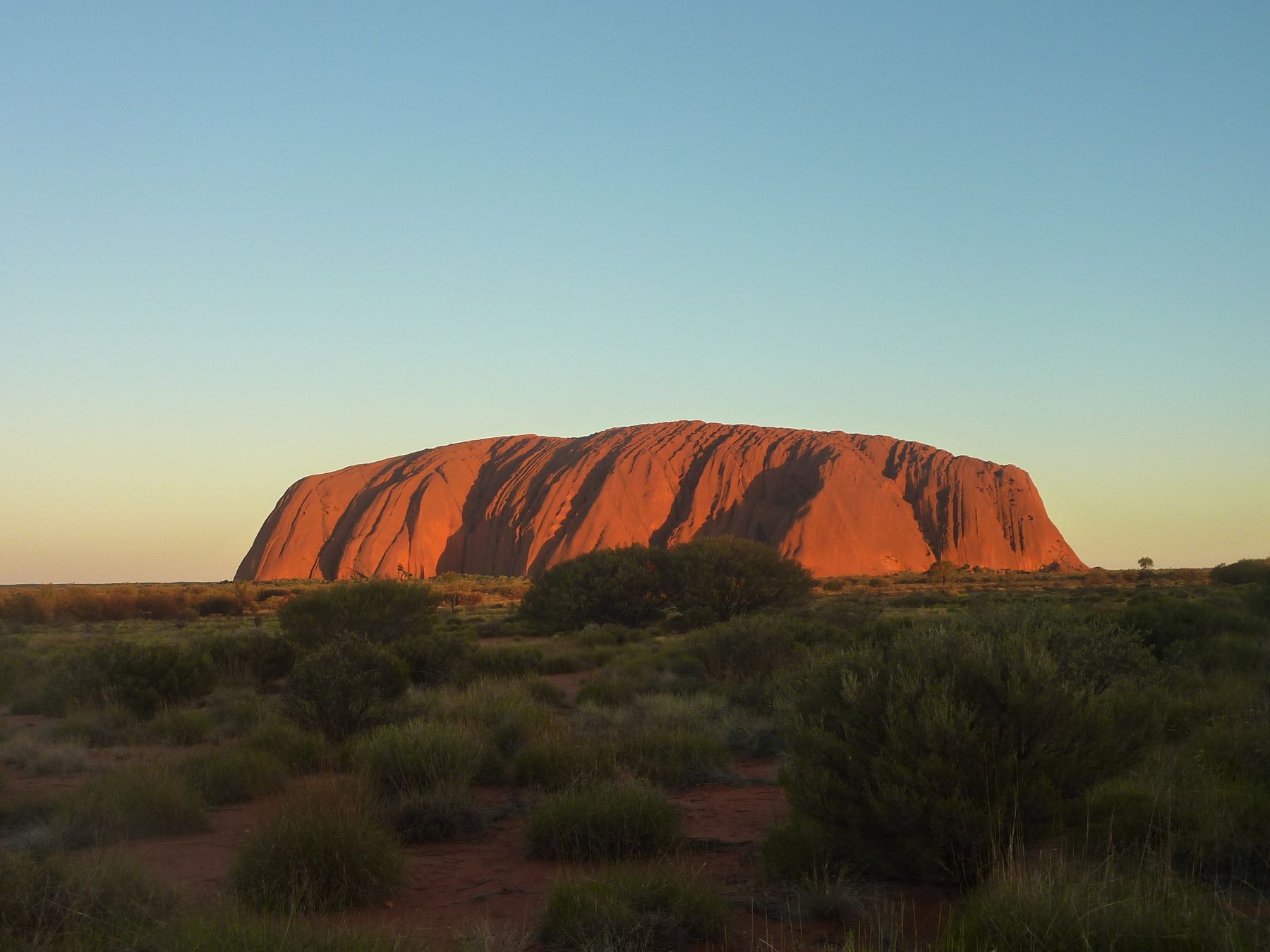
Watch sunrise from Talinguru Nyakunytjaku, the main sunrise area, and sunset from the car sunset viewing area. Each needs a valid park pass.
- Talinguru Nyakunytjaku: two viewing platforms and a few kilometres of track, with Uluru and Kata Tjuta in the same view. It has toilets, and it is also a quieter choice for sunset.
- Car sunset viewing area: the classic view, about 15 to 20 minutes' drive from Yulara. Cars only, no water or toilets. It is busy in school holidays, so arrive early and walk to the far end near the fence.
- Bus sunset viewing area: for tour coaches, with a sandy dune walk and a 360° view.
- Kata Tjuta: the dune viewing area is 26 km along the Kata Tjuta road. If you stay for sunset there, you must be out of the park by closing time.
Check the monthly hours in the table above when planning, as sunset at Kata Tjuta is about 50 km from Yulara. Drones are banned in the park, and Parks Australia asks you to photograph Uluru as a whole rather than zooming in, because many sites are sacred.
How many days do you need at Uluru?
Plan on two to three full days, which matches the three-day park pass. That gives you two sunrises and two sunsets, a morning on the base walk, a morning at Kata Tjuta and time at the Cultural Centre, which Parks Australia suggests visiting first.
- Day 1: sunrise at Talinguru Nyakunytjaku, the Cultural Centre, sunset from the car viewing area.
- Day 2: the Uluru base walk at dawn, rest at midday, the Field of Light after dark.
- Day 3: Valley of the Winds or Walpa Gorge at Kata Tjuta, then sunset at Kata Tjuta.
Add a day or two for Kings Canyon or the drive to Alice Springs. To hear about Country from Anangu guides, see our pick of Aboriginal cultural tours, and for the geology and the story of the climb's closure, read Uluru, Kata Tjuta and the Red Centre explained.
How do you get to Uluru, and how much is the park pass?
Most visitors fly into Ayers Rock (Connellan) Airport, about 10 minutes from Ayers Rock Resort at Yulara. Qantas, Jetstar and Virgin Australia fly direct from several Australian cities, though routes change by season. Free AAT Kings coach transfers meet scheduled flights for resort guests, with no booking needed.
By road, the park is about 450 km south-west of Alice Springs. It is a long day's drive each way, so consider combining it with Kings Canyon on a Red Centre loop. See the Northern Territory guide for the wider region.
Everyone entering Uluru-Kata Tjuta National Park needs a pass. It costs A$38 per adult for three days or A$50 for an annual pass, and under-18s are free. Buy it online from Parks Australia before you arrive.
When is Uluru busiest, and when should you book the Field of Light?
Uluru is busiest in the cool months and during Australian school holidays. In 2027, Northern Territory school holidays fall roughly from 3 to 12 April, 19 June to 12 July and 18 September to 4 October, and other states have their own dates around the same times.
Almost all beds near the park are at Ayers Rock Resort, so book your room first, then tours. For June to September, book weeks ahead. Our guide to what to book ahead in Australia covers the other bookings worth making early.
The Field of Light, artist Bruce Munro's installation of about 50,000 glowing spheres, covers more than seven football fields of desert within sight of Uluru. You can walk through it with general admission, add a dune-top viewing with canapés and drinks, or book a dinner package. Sessions run after dark and are booked through Ayers Rock Resort; in the peak season, book them as soon as your dates are fixed.
Facts checked October 2026. Climate figures are long-term averages, and park hours, track closures, flights and prices change; check Parks Australia and the forecast before you go.
- When to come (Parks Australia, Uluru-Kata Tjuta National Park)
- Climate statistics for Yulara Airport (Bureau of Meteorology)
- Opening hours (Parks Australia, Uluru-Kata Tjuta National Park)
- Extreme temperatures fact sheet (Parks Australia)
- Valley of the Winds walks (Parks Australia)
- Uluru-Kata Tjuta National Park visitor guide (Parks Australia)
- Uluru car sunset viewing area (Parks Australia)
- Talinguru Nyakunytjaku viewing area (Tourism NT)
- Uluru-Kata Tjuta park passes (Parks Australia)
- Getting here (Ayers Rock Resort)
- Airport transfers FAQ (Ayers Rock Resort)
- Field of Light tours (Tourism NT)
- School term and holiday dates in NT (Northern Territory Government)