Every 25 April, Australians get up in the dark to stand in silence at war memorials across the country. ANZAC Day began as a way to remember the Gallipoli landing of 1915 and now honours everyone who has served. Here is what the day means, what happens at a dawn service, and how visitors can take part respectfully.
What is ANZAC Day and why is it on 25 April?
ANZAC Day is Australia's national day of remembrance for everyone who has served and died in war, and it falls on 25 April because that is the date Australian and New Zealand troops landed at Gallipoli in 1915. New Zealand marks the same day.
The first commemorations were held on 25 April 1916, with ceremonies across Australia, a march of more than 2,000 Australian and New Zealand troops through London and a sports day in the Australian camp in Egypt. By 1927 every state observed some form of public holiday on the day. Today it covers all conflicts and peacekeeping operations, not only Gallipoli.
What does ANZAC stand for?
ANZAC stands for the Australian and New Zealand Army Corps, the formation the two countries' troops served in during the First World War. The soldiers became known as Anzacs, and the beach where they landed is still called Anzac Cove. The word is protected by law in Australia, so businesses generally need permission from the Department of Veterans' Affairs to use it commercially.
What happened at Gallipoli in 1915?
Gallipoli was a failed eight-month Allied campaign on a peninsula in what is now Türkiye, launched to help a British naval force break through the Dardanelles strait and capture Constantinople, then the Ottoman capital.
- The landing: Australian and New Zealand troops came ashore at Anzac Cove on 25 April 1915 and met fierce Ottoman resistance on steep ridges.
- August offensive: Lone Pine cost more than 2,000 Australian casualties over four days. At The Nek on 7 August, more than 370 Australians were killed or wounded.
- Stalemate: after August, neither side broke through for the rest of 1915.
- Evacuation: the Anzac sector was evacuated on 19 and 20 December 1915, with very few casualties. It is often called the campaign's most successful operation.
About 60,000 Australians served there. The Australian War Memorial records 26,111 Australian casualties, including 8,141 deaths; the Department of Veterans' Affairs gives a rounded figure of some 8,700 killed. Ottoman, British, French and other Allied forces also suffered heavy losses.
Why does Gallipoli matter to Australians?
Gallipoli matters because it was one of the first major events Australians faced as a new nation, federated only in 1901, and it shaped a lasting story about national character. That story, often called the Anzac legend, values courage, endurance, humour and mateship.
Historians note that the campaign failed militarily, and some argue it had little influence on the course of the war. Its weight is in memory rather than victory. Many people today also use the day to reflect on the cost of war more broadly, and there is ongoing public debate about how the conflicts between colonists and First Nations peoples on Australian soil should be remembered. Our guide to the history of Australia puts Gallipoli in that wider timeline.
What happens on ANZAC Day?
The day starts with a dawn service, follows with marches by veterans and their families, and ends for many people at an RSL club or pub. Dawn services draw on the army's "stand-to" before first light. Organised dawn services are usually traced to the Sydney Cenotaph in 1928, when about 150 people gathered.
- The Last Post: a bugle call marking the end of the day, played as a tribute to the dead and followed by a silence. At dawn services the longer Reveille follows; at other services, the Rouse.
- The Ode: the fourth verse of Laurence Binyon's poem For the Fallen, first published in 1914 and used in Australian services since 1921. It ends "We will remember them", which the crowd repeats.
- "Lest we forget": the closing response you will hear after the Ode and on many memorials.
- Rosemary: it grows wild on the Gallipoli peninsula, and people wear a sprig as a symbol of remembrance.
- Two-up: a coin-tossing game played by soldiers in the First World War. State and territory laws generally ban it but allow it on designated days of remembrance such as ANZAC Day, under rules that differ by state. In Queensland, for example, it must be run by an RSL or services club or with RSL approval.
As a visitor, stand when others stand, remove your hat for the Ode and stay quiet during the silence.
Did Aboriginal and Torres Strait Islander people serve at Gallipoli?
Yes. Australian War Memorial historians believe about 70 Aboriginal men served on Gallipoli and 13 were killed, although an exact count may never be possible. AIATSIS says more than 1,000 Aboriginal and Torres Strait Islander people served in the First World War.
Many enlisted by hiding their identity, as early attempts were often rejected. A 1917 military order allowed men to enlist only if one parent was "of European origin", as judged by medical officers. After the war, many returned to discrimination and were denied jobs and benefits given to other returned servicemen.
Recognition has grown. The Australian War Memorial's sculptural memorial For our Country, by artist Daniel Boyd with Edition Office architects, was dedicated in March 2019 to honour First Nations service in every conflict. On ANZAC Day the Memorial also hosts a ceremony by the Aboriginal and Torres Strait Islander Veterans Association. Our introduction to Aboriginal and Torres Strait Islander culture is a good next read.
What is the difference between ANZAC Day and Remembrance Day?
ANZAC Day (25 April) is Australia's main day of remembrance and is linked to Gallipoli, while Remembrance Day (11 November) marks the armistice that ended the fighting of the First World War in 1918.
On Remembrance Day people pause for silence at the eleventh hour of the eleventh day of the eleventh month, and many wear a red Flanders poppy. It is a working day, not a public holiday, and services are shorter and smaller than on ANZAC Day.
Where can visitors attend ANZAC Day services?
Almost every town holds a dawn service, and visitors are welcome at all of them with no ticket. City services get very crowded, so arrive early, dress warmly and use public transport. Outside 25 April, the main memorials are free to visit all year.
| Place | Where | On ANZAC Day | Rest of the year |
|---|---|---|---|
| Australian War Memorial | Canberra, ACT | Dawn Service and National Ceremony | Free, 10am to 5pm; Last Post Ceremony daily |
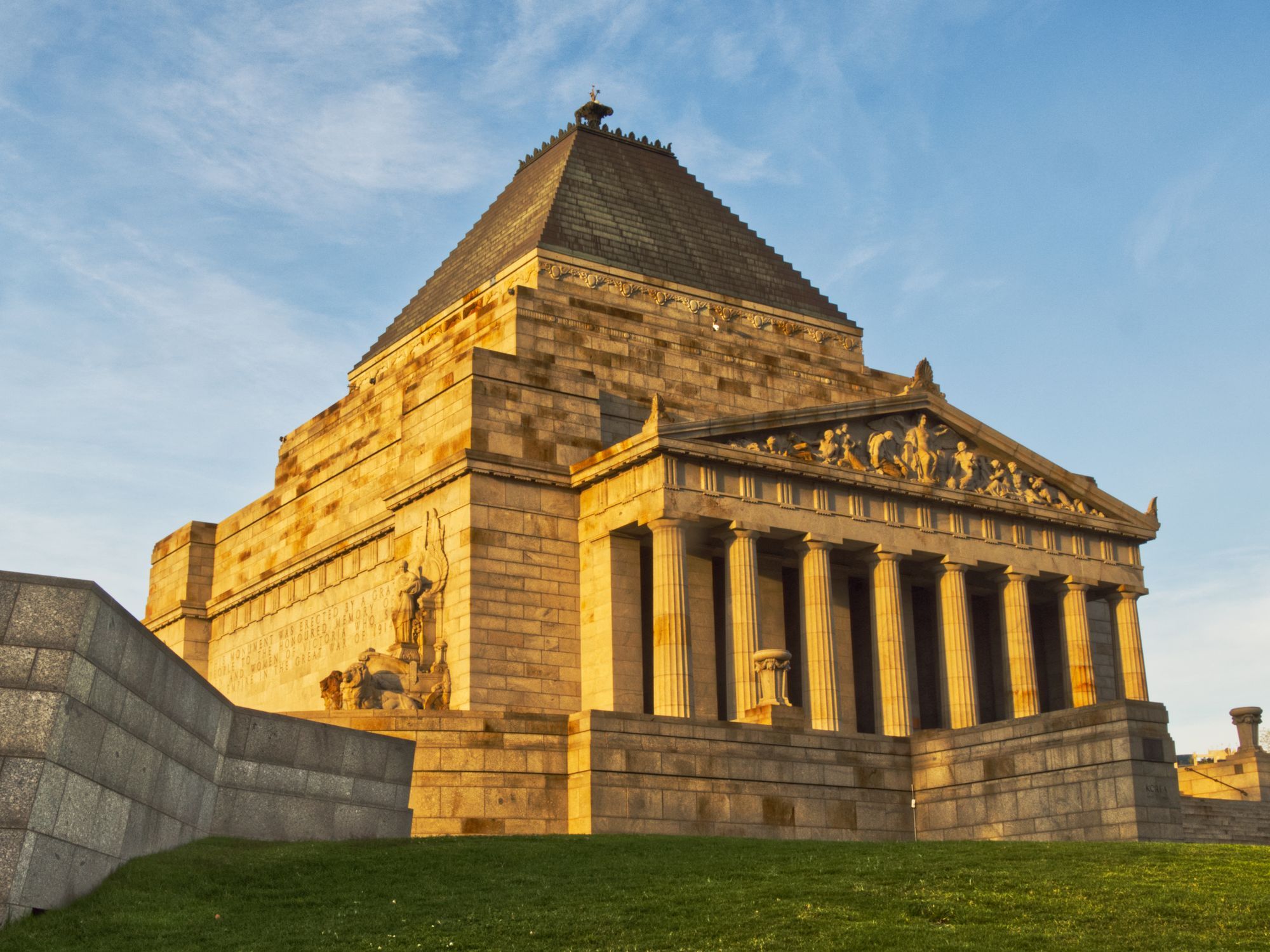
| Shrine of Remembrance | Melbourne, Victoria | Dawn Service at 5.30am in 2026, no bookings | Free, 10am to 5pm |
| Anzac Memorial, Hyde Park | Sydney, New South Wales | City commemorations nearby | Free, 9am to 5pm; service daily at 11am |
| Anzac Commemorative Site | Gallipoli, Türkiye | Dawn Service, then Lone Pine or Chunuk Bair | Gallipoli Peninsula historic sites |
In Melbourne, the Shrine sits a short walk from the city on St Kilda Road; see our Victoria guide. In Sydney, the Anzac Memorial is in Hyde Park, and our New South Wales guide covers the rest of the city.
Going to Gallipoli: the Australian Government's services there need a free individual attendance pass for every person, and a tour booking does not replace it. There is no ballot. For 2026 the site opened at 10.30pm on 24 April, with last entry around 3am. Expect airport-style security, a cold night outdoors with no shelter, and up to 8 km of walking. Registration for 2027 is due to open towards the end of 2026 through the Department of Veterans' Affairs.
Is ANZAC Day a public holiday, and what is open?
Yes, ANZAC Day is a public holiday in every state and territory. In 2027, 25 April falls on a Sunday. New South Wales, Western Australia and the ACT add a public holiday on Monday 26 April, and Queensland and the Northern Territory observe it on the Monday. Victoria, South Australia and Tasmania keep the Sunday only.
- New South Wales: ANZAC Day is a restricted trading day, so most shops and all banks stay closed. Cafés, restaurants, pharmacies, petrol stations and small shops can open.
- Victoria: most shops cannot open until 1pm.
- Elsewhere: rules vary, so expect reduced trading in the morning and check before you plan a shopping day.
In Melbourne, extra early trams, trains and buses run for the dawn service, and roads around the Shrine close until the afternoon. If you are planning a late-April trip, see our month-by-month guide and remember that pubs, beaches and parks stay busy all afternoon. For more on behaving well at memorials and cultural sites, read visiting Australia respectfully.
Facts checked October 2026. Service times, Gallipoli registration and holiday arrangements are set each year; confirm with the Department of Veterans' Affairs, the memorial or your state government before you travel.
- Gallipoli (Australian War Memorial)
- Gallipoli media backgrounder (Department of Veterans' Affairs)
- ANZAC Day traditions (Australian War Memorial)
- Ode of Remembrance and other poems (DVA Anzac Portal)
- Commemorative traditions (Veterans NSW)
- Serving their country (AIATSIS)
- Aboriginal presence on Gallipoli grows (Australian War Memorial)
- For our Country: Aboriginal and Torres Strait Islander memorial (Australian War Memorial)
- Anzac Day, Gallipoli, Türkiye (Department of Veterans' Affairs)
- Protecting the word 'Anzac' (Department of Veterans' Affairs)
- Plan your visit (Shrine of Remembrance)
- 2027 public holidays (Fair Work Ombudsman)
- Trading on public holidays in NSW (NSW Government)